
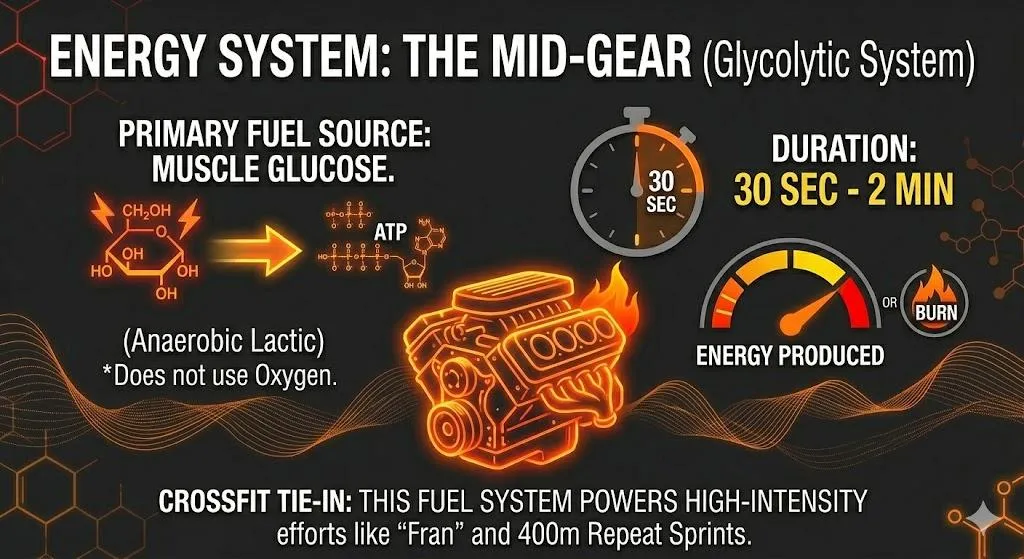
The "Pain Cave" (Glycolytic System)
Welcome to the Burn: Why We Venture into the "Pain Cave"
If you have ever done the CrossFit workout "Fran" (21-15-9 Thrusters and Pull-ups), you know exactly where we are going today. About 90 seconds into that workout, your chest feels like it’s full of glass, your quads are screaming, and your brain is pleading with you to stop.
That discomfort has a name: The "Pain Cave," and biologically, it is your Glycolytic System (your "Mid-Gear") working overtime.
What is it?
The Glycolytic system is your intermediate engine. It picks up right where our last article of the Sprinter Engine (the Phosphagen system) leaves off. It provides the dominant fuel source for maximal efforts lasting between 30 seconds and approximately 2 minutes.
Unlike yesterday’s raw power engine, which burns stored chemical energy, this system burns a real fuel: Glucose (sugar). However, because the intensity is so high and the timeframe is so short, your body does not have time to use oxygen to burn that sugar. This is why it is called Anaerobic (meaning "without air").
Because it burns fuel "fast and dirty" (without oxygen), it creates a buildup of metabolic byproducts (often called lactate, though the reality is more complex). That acid buildup in the muscle cells is what causes the infamous, painful "burn" and inevitable muscle fatigue.
The "Dark Place" in CrossFit
You expose your athlete to this uncomfortable but critical system every time we program high-effort bursts:
"Fran" (for most fast athletes).
400m Repeat Sprints.
The central 60 seconds of a max-rep wall-ball set.
A 500m Row Sprint for Time.
Why We Train It (The Superpower Story)
This system is, without question, the most uncomfortable one to train. Why do we put you through that specific misery?
1. Increased Anaerobic Lactic Threshold: The more you train in this unpleasant zone, the better your body becomes at "buffering" the acid buildup. This means you can maintain that incredibly high power output for longer before the fatigue forces you to slow down. You don't just feel better; you perform at a higher level.
2. Radical Body Composition Shift: The Glycolytic engine is inefficient, and in this case, that’s a good thing. It demands an immense amount of calorie burn during the short effort. Even better, it creates a significant "Oxygen Debt" (EPOC), meaning your metabolism stays elevated, burning fat for hours after you finish the workout. This system is the engine behind the classic CrossFit lean physique.
3. Unmatched Mental Toughness: When we train the other systems, we are mostly training the muscles. When we train the Glycolytic system, we are training your brain. Learning to keep moving when every signal in your body is screaming at you to quit creates a profound resilience that translates directly to handling stress in the real world. This is where we learn how to suffer.
Embrace the Discomfort
Next article, we are going to look at the system that clears this acid and lets you breathe. But today, remember: when you feel that burn, you aren't just "hurting"...you are building mental resilience, forging a powerful metabolism, and building true high-intensity fitness.
The Effects of CrossFit® Practice on Physical Fitness and Overall Quality of Life. https://pmc.ncbi.nlm.nih.gov/articles/PMC11764515/

Gym Cartel is dedicated to helping all people to appreciate that being active and healthy is one of the greatest gifts of life.

CROSSFIT DESIRE CENTRAL



Copyright ©2024 Gym Cartel Albion. All rights reserved