
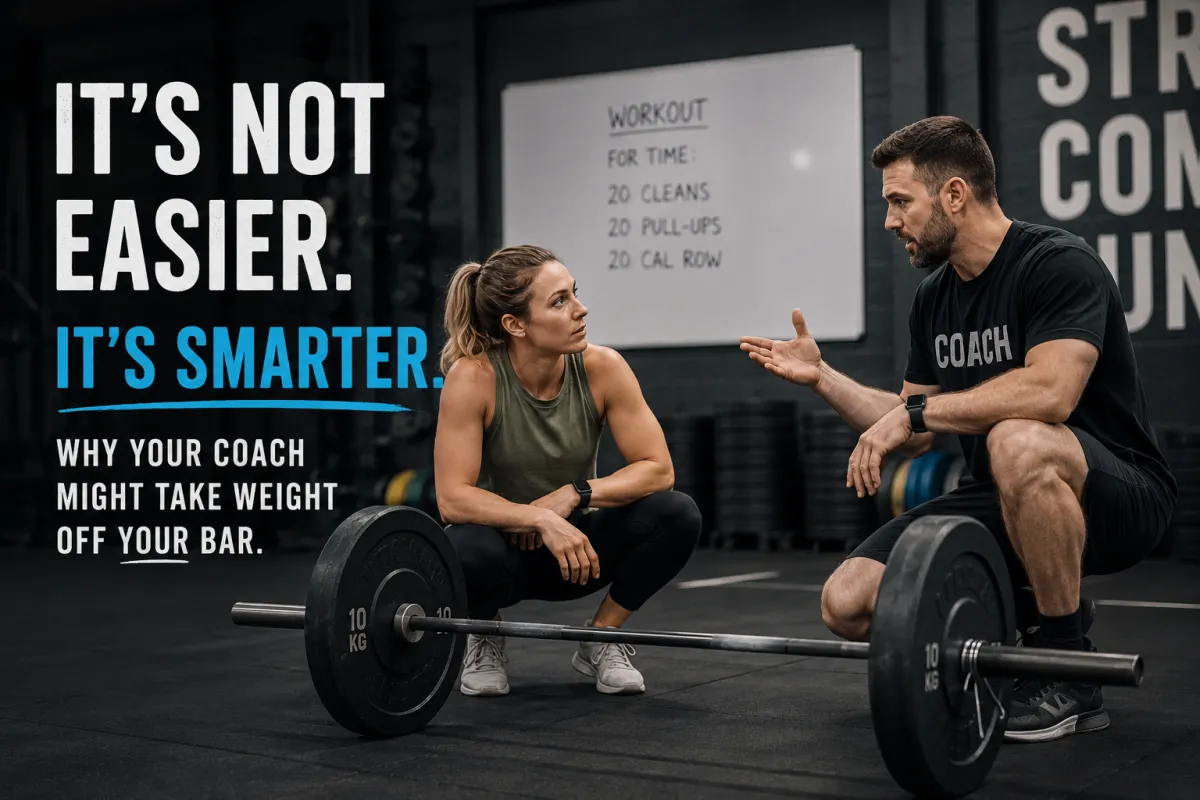
Why Your Coach Took Weight Off Your Bar
There’s a moment that happens in CrossFit gyms all the time.
You’ve got a weight on the bar. You know you can lift it. Maybe you’ve lifted considerably more before.
Then your coach walks over, watches a couple of reps and says:
“Take 10kg off.”
It can be frustrating.
You might wonder whether they think you’re not strong enough. You might feel like they’re making the workout easier. And if the prescribed weight is sitting there on the whiteboard, there can be a temptation to think that doing anything less somehow means you’re not doing the “real” workout.
Usually, your coach is doing the opposite.
They’re trying to make sure you get the workout you were supposed to get.
Every CrossFit workout has a purpose
A good CrossFit workout isn’t simply a collection of movements designed to make you tired.
Every workout has an intended stimulus.
Maybe today’s workout is supposed to be fast, with very little standing around.
Maybe the barbell should feel moderately heavy, but still light enough that you can move confidently while your heart rate is elevated.
Maybe the goal is muscular stamina.
Maybe it’s a longer aerobic effort where you need to keep moving for 20 or 30 minutes.
And sometimes, yes, the goal genuinely is to lift something heavy.
Those are very different training sessions.
The weights, repetitions and movements written on the board are tools used to create that stimulus. They aren’t the stimulus themselves.
That distinction matters.
Imagine a workout calls for 20 cleans.
You choose a weight you know you can lift, but once the workout starts you're completing a rep, stepping away from the bar, breathing for 20 or 30 seconds and then attempting another.
Technically, you might be doing the prescribed weight.
But you may have completely changed the workout.
Take some weight off and suddenly you can perform three or four reps at a time. Your heart rate stays elevated. You’re forced to manage fatigue. Your technique remains better. You finish considerably faster.
Now you’re much closer to what the workout was designed to train.
And ironically, using less weight may have given you a harder and more effective training session.
Being able to lift it isn't always the question
This is where athletes can misunderstand what their coach is looking for.
Your coach often already knows you can lift the weight.
That's not necessarily the question.
The question might be:
Can you lift it repeatedly while fatigued and still move well?
Can you maintain your positions?
Can you keep the intended pace?
Can you recover quickly enough between sets?
Can you perform the movement safely when your breathing is heavy?
And does the workout you are doing still resemble the workout that was programmed?
Your one-rep max tells us something about your strength.
It doesn't automatically tell us what weight you should use for 30 reps in the middle of a conditioning workout.
Mechanics → Consistency → Intensity
One of CrossFit’s most important principles is:
Mechanics → Consistency → Intensity.
First, learn to move well.
Then demonstrate that you can move well consistently.
Then we start pushing the intensity.
The order matters.
Intensity is enormously important in CrossFit. It's one of the reasons the methodology works so well.
But intensity doesn't simply mean putting more weight on the bar.
Moving faster can create intensity.
Doing larger unbroken sets can create intensity.
Reducing rest can create intensity.
Maintaining a consistent pace for longer can create intensity.
Sometimes taking 10kg off the bar allows an athlete to train at a much higher relative intensity than stubbornly leaving it on.
This is where coaching matters
A coach isn't just standing there counting your repetitions.
They're watching how you're moving.
They're seeing how quickly you're recovering.
They're noticing whether your technique changes once you become fatigued.
They're considering your training history, experience and ability.
And they're comparing what you're doing with the intended stimulus of the workout.
Sometimes your coach will tell you to put more weight on the bar.
Sometimes they'll encourage you to move faster.
Sometimes they'll tell you to slow down.
Sometimes they'll change a movement.
And sometimes they'll tell you to strip a couple of plates off.
None of those decisions mean you're doing badly.
They're coaching decisions.
That's one of the major benefits of training in a coached environment rather than simply following workouts on your own.
Scaling isn't failing
This is one of the things we wish more people understood about CrossFit.
Scaling isn't a beginner version of CrossFit.
Scaling is CrossFit.
The goal isn't to eventually reach some magical point where you never modify another workout.
The goal is to become fitter.
And becoming fitter requires different things on different days.
Some days that means lifting heavy.
Some days it means going fast.
Some days it means practising a skill.
Some days it means choosing a lighter barbell so you can keep moving.
And sometimes an experienced athlete will need to modify a workout more than the person training beside them because they're dealing with an injury, managing fatigue, returning from time away or simply chasing a different stimulus.
Good athletes understand that.
The smartest athletes in the gym eventually stop asking:
“Can I do Rx?”
…and start asking:
“What weight should I use to get the most out of this workout?”
That is a much better question.
Trust the process
So next time a coach walks over and tells you to strip a couple of plates off the bar, don't automatically think:
“They don't think I can do it.”
Quite often, they're thinking:
“I know you can lift it. That's not what we're training today.”
And that's a very different thing.
The weight on the bar is only one part of the workout.
The goal is the adaptation that happens because of it.
Train the purpose of the workout—not your ego.

Gym Cartel is dedicated to helping all people to appreciate that being active and healthy is one of the greatest gifts of life.
CROSSFIT DESIRE CENTRAL


Copyright ©2024 Gym Cartel Albion. All rights reserved