
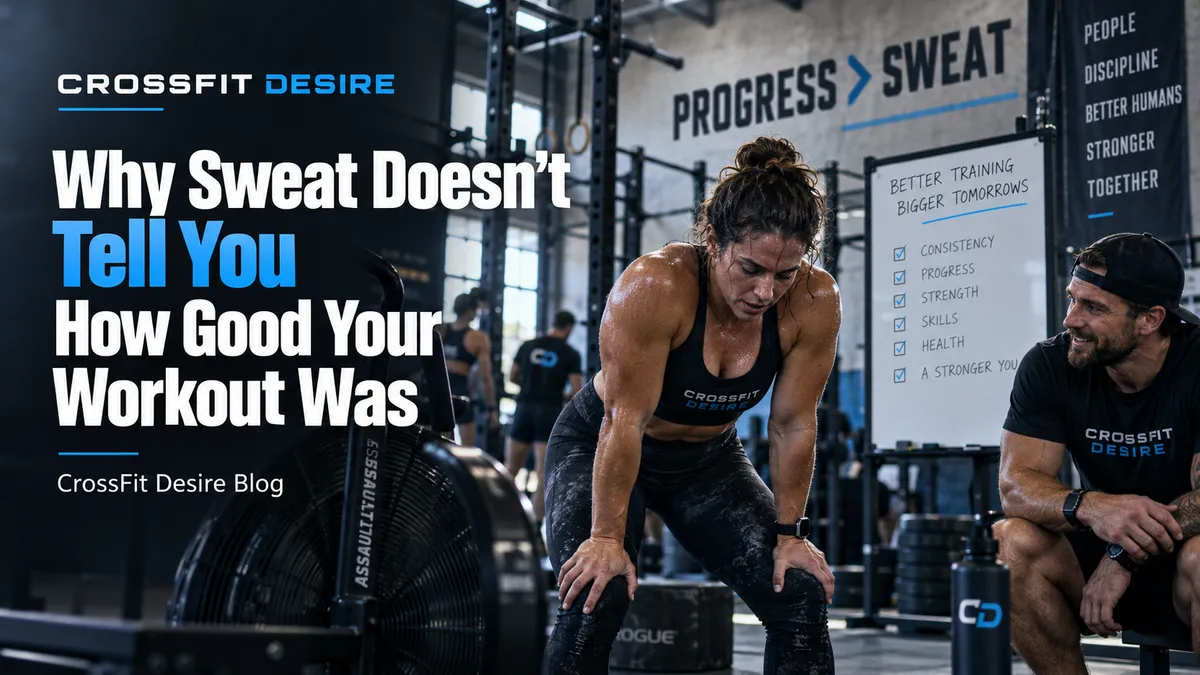
Why Sweat Doesn't Tell You How Good Your Workout Was
There’s something strangely satisfying about finishing a workout completely drenched.
Your shirt is soaked.
There’s a puddle underneath the bike.
You look like you’ve just jumped in a swimming pool.
It feels like proof that you worked hard.
But here’s the thing:
Sweat is not a fitness score.
It doesn’t tell you how many calories you burned, how much fat you lost or whether you had a better workout than the person standing beside you.
Sweating is primarily your body’s cooling system.
And that means there are plenty of reasons you might sweat more (or less) that have very little to do with the quality of your training.
Why Do We Sweat?
As your body temperature rises, your nervous system activates sweat glands in your skin.
Sweat reaches the surface of your body and, as it evaporates, helps remove heat.
That’s incredibly important during exercise.
But the amount you sweat can be affected by all sorts of things.
Temperature.
Humidity.
Clothing.
Genetics.
Body size.
Hydration.
How acclimatised you are to the heat.
Even two people doing exactly the same workout at exactly the same pace can finish looking completely different.
One might be dripping.
The other might barely look sweaty.
That doesn't necessarily mean one worked harder than the other.
Sweating More Doesn't Mean You're Burning More Fat
This is one of the most common fitness myths.
You might lose weight temporarily after a very sweaty workout, sauna session or long run in hot weather.
But most of that immediate drop on the scales is water loss.
Once you rehydrate, that weight returns.
Sweating doesn't mean fat is melting away.
Your long-term changes in body composition come from things like training consistently, building and maintaining muscle, nutrition, recovery and your overall energy balance.
Trying to make yourself sweat more isn't a shortcut.
A Workout Doesn't Need to Destroy You to Work
This is where things can become misleading.
People often judge their training using things like:
How sweaty was I?
How sore am I tomorrow?
How exhausted was I afterwards?
Those can all occur during effective training.
But none of them are the actual goal.
Imagine you spend an hour performing heavy squats with appropriate rest between sets.
You may not sweat anywhere near as much as you would during 20 minutes of burpees, running and rowing.
But that strength session could still be exactly what you need to become stronger.
Likewise, a session focused on technique might not leave you lying on the floor afterwards.
But if your snatch position improves, your squat becomes more controlled or you finally learn how to move efficiently on the rower, you achieved something worthwhile.
Every Workout Has a Different Purpose
CrossFit deliberately exposes us to different types of training.
Sometimes we lift heavy.
Sometimes we sprint.
Sometimes we work for 30 minutes.
Sometimes we're practising a skill.
Sometimes the challenge is maintaining a steady pace.
Sometimes the goal is simply moving really well.
Those sessions shouldn't all feel the same.
A five-minute conditioning workout might leave you gasping for air.
A heavy deadlift day might challenge your nervous system and strength without producing much sweat at all.
A long aerobic workout might feel controlled rather than brutal.
That variation is part of what makes the training effective.
The question shouldn't always be:
“How hard did that destroy me?”
A much better question is:
“Did I achieve what today's workout was designed to develop?”
Better Ways to Measure Progress
Fitness gives us plenty of useful things to measure.
Is your deadlift getting stronger?
Can you use a heavier dumbbell than six months ago?
Can you run the same distance faster?
Can you maintain a pace without needing as many breaks?
Are your movements becoming more efficient?
Are you recovering more quickly?
Can you now perform a movement you previously had to modify?
Are you training more consistently?
Those are meaningful signs that your fitness is improving.
Your sweat patch isn't.
Don't Chase the Feeling - Chase the Adaptation
There is absolutely nothing wrong with loving a hard workout.
Sometimes getting stuck into a tough conditioning session and walking away completely spent feels fantastic.
CrossFit should challenge you.
There will be workouts that leave your lungs burning and your clothes soaked.
But we don't need to manufacture that feeling every day.
Training works because the body is repeatedly exposed to appropriate challenges and adapts to them over time.
Sometimes that challenge is intensity.
Sometimes it's load.
Sometimes it's duration.
Sometimes it's skill.
Sometimes it's simply performing the basics better than you did last time.
So next time you finish training and wonder whether you did enough, don't look at the puddle underneath you.
Look at what you trained.
Look at the purpose of the session.
And look at where your fitness is heading.
Don't chase sweat.
Chase progress.

Gym Cartel is dedicated to helping all people to appreciate that being active and healthy is one of the greatest gifts of life.
CROSSFIT DESIRE CENTRAL


Copyright ©2024 Gym Cartel Albion. All rights reserved